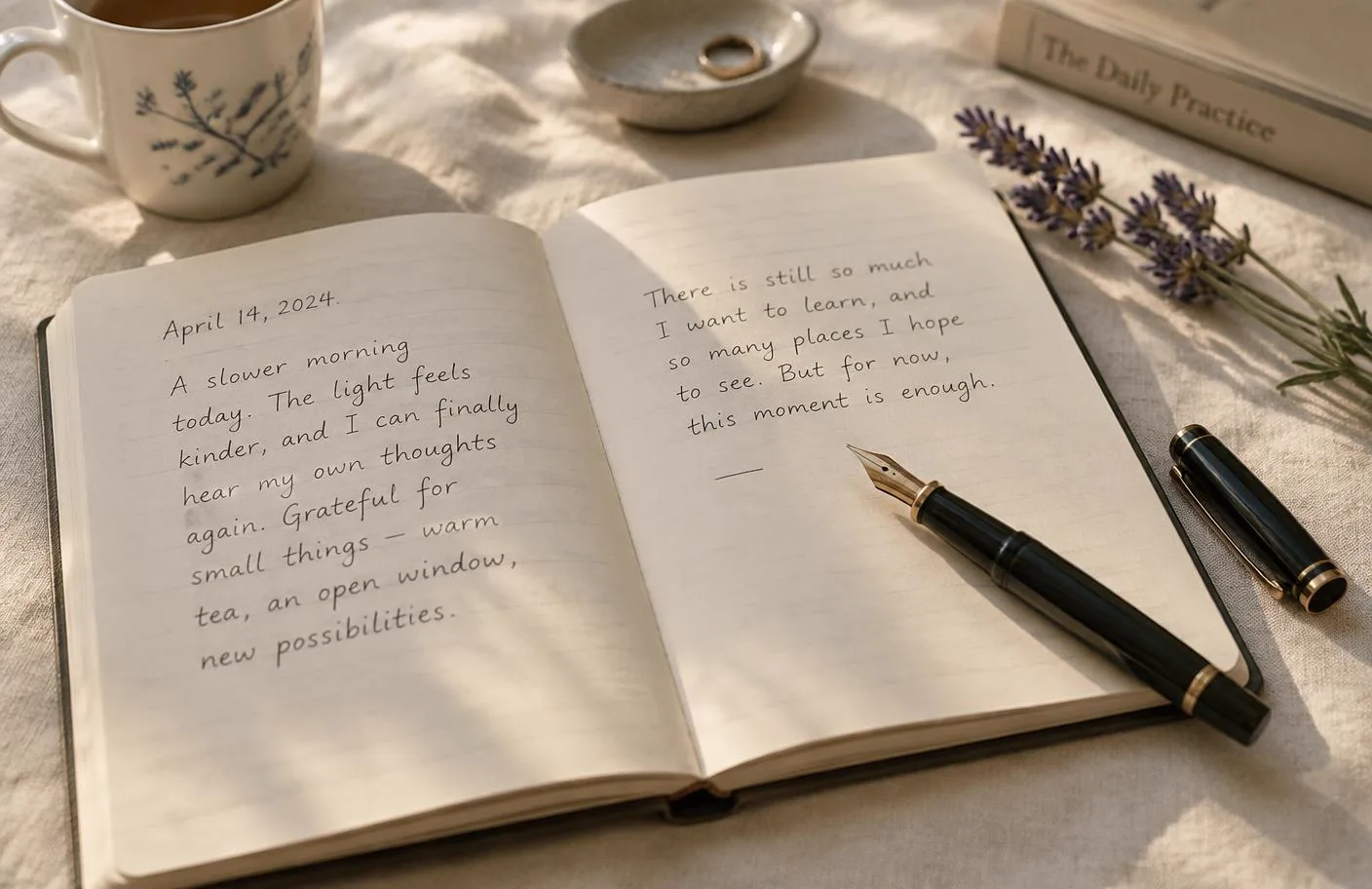
After a breakup, ordinary moments can bring questions you cannot answer. A journal offers somewhere to put those questions without sending them to your former partner. These seven days are a loose structure, not a deadline for feeling different. Write for five minutes, skip a prompt or repeat one. A few honest lines are enough.
Before you begin
This exercise is for adults aged 18 or older. It is personal reflection, not therapy, a prediction or a guarantee of reconciliation. Keep your notes somewhere private; you do not need to share them. Respect another adult's choices and any no-contact request. Writing is not a reason to send unwanted messages, check their accounts or ask friends to approach them.
Day 1: Separate facts from assumptions
Prompt: What do I know, and what am I guessing? Make two columns. 'They asked for no contact' is a fact; 'They will change their mind next week' is an assumption. You can acknowledge hope without calling it evidence. Small action: underline one fact you can act on today, such as respecting the requested distance. Leave unanswered questions unanswered.
Day 2: Name your feelings
Prompt: Which feelings are here today, even when they contradict each other? You might write sadness, anger, relief, affection or uncertainty. There is no correct combination. Describe what happened before a feeling appeared rather than judging yourself for having it. Small action: finish the sentence, 'Today feels difficult because…' You do not have to turn the answer into a solution.
Day 3: Notice personal boundaries
Prompt: What will I choose not to do, and what limits has the other person expressed? A boundary concerns your conduct, not a rule that makes someone return. Small action: draft one private sentence, such as 'I will not send another message when contact has been declined.' If necessary practical arrangements remain, do not use them as an opening for relationship pressure.
Day 4: Make room for ordinary routines
Prompt: Which everyday task needs a little attention? Choose something manageable: washing a cup, preparing tomorrow's clothes or sorting one piece of paperwork. This is not a test of productivity, and a completed task does not measure recovery. Small action: pick one task with a clear stopping point. Afterwards, write what you did, without requiring yourself to feel better.
Day 5: Identify supportive people
Prompt: Who can listen without pressuring me, taking sides or carrying messages to my former partner? Consider a trusted friend, relative or community member who respects privacy. Small action: ask for something specific, such as a short call or company while doing an errand. They may be unavailable; that does not decide your worth. Keep other people's private details out of shared notes.
Day 6: Return to your own values
Prompt: What matters to me in how I behave now? Choose two values, perhaps honesty, kindness, independence or respect. Write what each would look like in an ordinary decision. Small action: choose one value-led response today. If prayer, a familiar saying or a cultural practice is meaningful to you, include it optionally, without treating it as a way to influence another person's feelings.
Day 7: Choose one next step
Prompt: What small step is within my control next week? Review your notes for a practical choice, not a promised outcome. Small action: name one step and when you might take it. You may keep journaling, speak with someone supportive or seek appropriate professional advice. Spiritual services do not replace medical, psychological, legal or financial professionals. No particular result is guaranteed.
If you want a further conversation
You can read about relationship spiritual guidance and how consultations work before deciding whether to enquire. Consultations with Prince Edward are remote by phone, video or messaging. An initial enquiry asks about arrangements and is not a booking. The consultation fee is US$150 (USD) and covers the consultation only. Confirm the duration, scope and cancellation terms before booking and payment. Additional work is agreed separately. You may enquire if you wish, but using this journal does not require a consultation.